
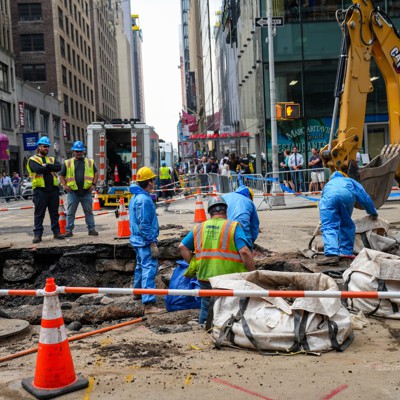
All you need to do to see how old and complex New York City really is, is look under our streets. The city’s underground infrastructure projects, including ours at the Department of Design and Construction (DDC), have uncovered all sorts of unexpected items: trolley tracks, fossils, oyster shells from old bars … but most frequently we encounter utility assets from ConEdison, National Grid, Verizon and others. Unlike many cities across the nation where utilities are strung overhead on poles, New York City has buried most of our utilities underground since the late 19th century.
Read more What Mamdani’s Office of Community Safety does in the aftermath of tragedy
Historically, this made the underground coordination between DDC, our contractors, and utility companies challenging and contributed to long delays and cost overruns when delivering infrastructure projects. It wasn’t until the aftermath of 9/11, when lower Manhattan needed to be rebuilt quickly, that the state Legislature gave New York City the ability to combine our public infrastructure work with utility work under the same contract.
For the first time, we could open the street together – DDC, contractors and utility companies – to install infrastructure in parallel and find space for everything. Projects like new water mains, sewer upgrades and street improvements could happen at the same time as moving a gas main and upgrading a steam main. That coordination, known as Joint Bidding, continues today, giving the city our best chance to avoid costly delays. Without it, we can’t do the necessary pre-planning work that is required, and contractors must negotiate with each and every utility company about the cost and scope of the necessary work once we open up the street. This can lead to delays and impacts to communities.
This year, we have received a one-year extension – we are happy the program is moving forward until the end of 2027, but we need a long-term extension. This issue is too important for the sake of our infrastructure projects and our city.
The Joint Bidding program has been a success. Over the past few years, the three parties – DDC, utility companies and our contracting community, mainly via the General Contractors Association and the Road Contractors Association – have worked together to ensure the contracting terms have the right checks and balances for all parties to help deliver infrastructure projects faster and on budget.
Read more NYPD inspector investigated in psych eval scandal getting promoted
The rollout of Joint Bidding hasn’t been perfect, but we’re always finding new ways to improve the program. One of DDC’s most recent updates is now known as “Joint Bidding-Open Competitive,” or “JB-OC” for short. JB-OC’s new contract terms award projects to the contractors who bid the lowest combined total for the public and private work.
JB-OC has been a labor of love for the three groups that drive these projects. The reality is that we three need one another. Without coordination between DDC, contractors and utilities, projects become more expensive, take longer to complete and create greater disruption for everyday New Yorkers. JB-OC is designed to better align incentives, improve accountability and ensure all parties are working toward the same public good. DDC intends to continue with the JB-OC framework over the next three years while tweaking the contract terms as needed in coordination with our partners.
The process of upgrading our Joint Bidding program will likely never end because we may keep encountering new issues in our streets, but my commitment as commissioner is simple: continue strengthening coordination between DDC, utilities and our contractors to meet the demands of a growing city and the delivery timelines and cost efficiencies New Yorkers expect.
New Yorkers may never see most of the work beneath their streets. But they feel the difference when it is done right. We will be back in Albany next year pushing for a commonsense, long-term renewal to help us keep New York City moving forward.